
Ages 13-18 with any anxiety disorder
31.9%
NIMH reports lifetime prevalence of any anxiety disorder among adolescents ages 13-18, and trauma reminders can overlap with anxiety and avoidance.
Trauma-informed support
Parent-focused guidance on trauma responses, avoidance, emotional reactivity, trust, safety, pacing, and treatment readiness.

Trauma-informed assessment
Trauma exposure and PTSD symptoms cannot be understood from one number alone. National mental health data show why trauma-informed assessment should look at sleep, school, mood, anxiety, safety, relationships, and the teen's ability to feel safe enough to use help.
31.9%
NIMH reports lifetime prevalence of any anxiety disorder among adolescents ages 13-18, and trauma reminders can overlap with anxiety and avoidance.
20.1%
NIMH reports that about one in five U.S. adolescents ages 12-17 had a past-year major depressive episode in 2021.
40%
CDC 2023 YRBS data show persistent sadness or hopelessness remains widespread among high school students.
20%
CDC 2023 YRBS data show one in five high school students seriously considered attempting suicide, making safety assessment essential when trauma symptoms are present.
Understanding the concern
A diagnosis or symptom pattern is only one part of the picture. Families also need to consider safety, functioning, school, relationships, routines, and what level of support is realistic at home.
Trauma can affect how a teen reads safety, trust, relationships, body signals, and everyday stress. A teen may seem angry, avoidant, controlling, numb, or defiant when the deeper pattern involves fear, shame, or protection. Trauma-informed care does not excuse unsafe behavior, but it asks what may be happening underneath the behavior.
PTSD and trauma-related symptoms should be assessed by qualified professionals. Many teens need stabilization, coping skills, sleep support, family safety, and trust before deeper trauma processing is appropriate. Pacing matters because moving too fast can intensify symptoms or avoidance.
Some teens look scared after trauma. Others look angry, shut down, controlling, sarcastic, numb, restless, impulsive, or impossible to reach. A teen may reject comfort because closeness feels unsafe, argue over small limits because control feels necessary, or act as if nothing happened because feeling the truth would be too much. Parents may be looking for sadness and instead see defiance.
This is one reason trauma-informed care matters. It does not mean every behavior is blamed on trauma or that limits disappear. It means adults ask a better question before responding: is this teen trying to protect themselves, avoid a reminder, regain control, escape shame, or survive a body alarm that feels bigger than the situation in front of them?
Avoidance is understandable after painful experiences. A teen may avoid people, places, smells, tones of voice, conversations, clothing, cars, bathrooms, school hallways, certain assignments, family members, sleep, or emotions themselves. Avoidance can bring short-term relief, but over time it can make the teen's world smaller and more fragile.
Parents may not know whether to push or protect. Pushing too hard can make the teen feel trapped or unsafe. Protecting too much can let trauma decide what life is allowed to include. A good plan helps the teen build stability, choice, and skills before asking them to approach reminders they are not ready to face.
Families sometimes assume trauma treatment means the teen must talk through what happened right away. For many adolescents, that is not the first step. Stabilization may involve sleep support, grounding skills, safety planning, emotional regulation, predictable routines, family communication, school support, and helping the teen understand body signals without being overwhelmed by them.
When stabilization is skipped, deeper processing can backfire. The teen may shut down, escalate, dissociate, self-harm, use substances, refuse therapy, or become more avoidant. Trauma processing can be powerful when the teen is ready, but readiness should be assessed by trained clinicians rather than forced by a schedule.
Trauma often affects trust even when the family was not the source of harm. A teen may hide details, reject questions, test whether adults will leave, or assume that help comes with judgment. Parents may feel shut out, blamed, or afraid to set limits because they do not want to make things worse.
Family work can help caregivers support safety without interrogating, validate pain without removing all expectations, and repair ruptures without demanding immediate openness. Trust usually returns through repeated predictable moments, not one perfect conversation.
Residential treatment may be worth discussing when trauma-related symptoms are disrupting safety, school, sleep, family functioning, or outpatient progress, especially when trauma overlaps with depression, anxiety, self-harm, suicidal thoughts, substance use, eating concerns, or severe avoidance. The program should be clear about what trauma-informed care means in daily practice, not only in marketing language.
Families should ask whether trauma-specific therapies are available, who provides them, how readiness is assessed, how staff respond to triggers, what happens after nightmares or dissociation, how family work is paced, and when referral to a different level or specialty trauma service may be needed.
If a teen is in immediate danger, may harm themselves, may harm someone else, is psychotic, intoxicated, unable to stay safe, or has a suicide plan or access to lethal means, seek emergency support first. Call 911, go to the nearest emergency room, or call or text 988 in the United States.
Signs and symptoms
The signs below should not be used for diagnosis. They are starting points for a conversation with a qualified professional or admissions specialist.
Parent planning
A clear pattern is more useful than a perfect label. Before an admissions or clinical conversation, parents can write down what they are seeing, how often it happens, and how it affects daily life.
Daily life impact
Trauma symptoms can affect sleep, school, friendships, family trust, emotional regulation, and a teen's willingness to accept help. Parents may notice avoidance, shutdown, sudden anger, anxiety, body complaints, or intense reactions that seem bigger than the situation in front of them.
Daily life may become unpredictable because reminders are not always obvious. A tone of voice, crowded room, hallway, smell, joke, touch, correction, or family argument can set off a reaction that looks disconnected from the present moment. The teen may not always understand the connection either.
Parents may start walking carefully around topics, avoiding limits, or trying to decode every reaction. A treatment plan should help the family create predictability and safety without letting trauma make every household decision.
Residential treatment fit
Residential treatment may be worth discussing when trauma-related symptoms overlap with safety concerns, major school or family disruption, self-harm, substance use, or an inability to stabilize with outpatient care. A program should be clear about what trauma-specific services it offers and what requires referral.
It may also be worth discussing when the teen needs more structure, observation, and skills practice than weekly therapy can provide. Residential care can help when the day itself has become unstable: sleep is disrupted, school is not happening, family conflict is escalating, and the teen cannot use coping skills outside a session.
Residential treatment is not the right substitute for emergency care when risk is immediate. It also should not promise intensive trauma processing before the teen is ready. Stabilization, trust, and careful pacing may be the clinically appropriate first phase.
Treatment approach
A trauma-informed approach emphasizes safety, predictability, skill-building, consent, collaboration, and careful pacing. Trauma-specific therapies may be appropriate for some teens, but readiness should be assessed before any deeper processing begins.
Treatment may include grounding skills, emotional regulation, sleep support, family therapy, safety planning, school coordination, coping practice, and psychoeducation about trauma responses. Trauma-specific work should be provided by appropriately trained clinicians and matched to the teen's readiness, symptoms, and safety.
Good trauma-informed care should be visible in ordinary moments: how staff give directions, respond to refusal, handle conflict, support transitions, respect privacy, and explain limits. The daily environment matters as much as the therapy modality listed on a website.
NorthLeaf support
Treatment planning should connect symptoms with daily functioning, safety, family needs, school needs, and the next level of support after residential care.
Deeper parent guide
These sections are written for parents who need more than a symptom checklist. They focus on the patterns that can keep a teen stuck, what families often miss, and what good treatment planning should clarify before any level-of-care decision.
Trauma symptoms in teens are often misunderstood because they can look like defiance, avoidance, emotional overreaction, numbness, distrust, perfectionism, shutdown, risky behavior, or sudden anger. The behavior still matters, but the meaning underneath may be protection rather than simple opposition.
A teen does not need to describe every detail of what happened before support can begin. Trauma-informed care usually starts with safety, predictability, consent, grounding, emotional regulation, and trust. Pushing disclosure too early can increase avoidance or flooding.
A best-in-class trauma page should help parents understand the difference between trauma-informed stabilization and trauma processing. Stabilization can be treatment, not a delay.
A steadier parent phrase is: 'You do not have to tell me everything right now for me to believe that something feels unsafe. We can work on safety, trust, and next steps first.'
NorthLeaf treats adolescents whose trauma symptoms are affecting safety, school, sleep, relationships, emotional regulation, or daily functioning and who need a more predictable setting to stabilize. Trauma history alone does not determine level of care; current functioning, medical stability, risk, and ability to participate safely in residential treatment matter.
Family work can help parents respond to triggers, set boundaries without escalating shame, support stabilization, and understand how to communicate with a teen who may be protective, mistrustful, or overwhelmed.
Parents may need help learning when to ask questions, when to pause, how to validate without pressing for details, how to set limits predictably, and how to repair after conflict. Family involvement should help caregivers become safer and steadier, not perfect.
Trauma can affect concentration, attendance, peer relationships, avoidance, and reactions to authority or crowded settings. Academic planning should account for safety and regulation, not only assignments.
School may contain reminders the family does not see: hallways, bathrooms, peers, noise, pressure, authority figures, or assignments that touch painful material. A school plan may need attendance goals, communication with staff, workload triage, grounding strategies, and gradual re-engagement.
Related conditions
Support for teens whose anxiety is making life smaller at school, at home, with friends, or in daily routines.
Support for adolescents experiencing persistent sadness, withdrawal, low motivation, or emotional heaviness.
Clinically responsible guidance when self-harm behaviors or urges require careful safety planning and support.
Related resources

A parent guide to teen trauma symptoms that may look like anger, avoidance, shutdown, anxiety, school refusal, substance use, or family conflict.
By NorthLeaf Editorial Team
Read Guide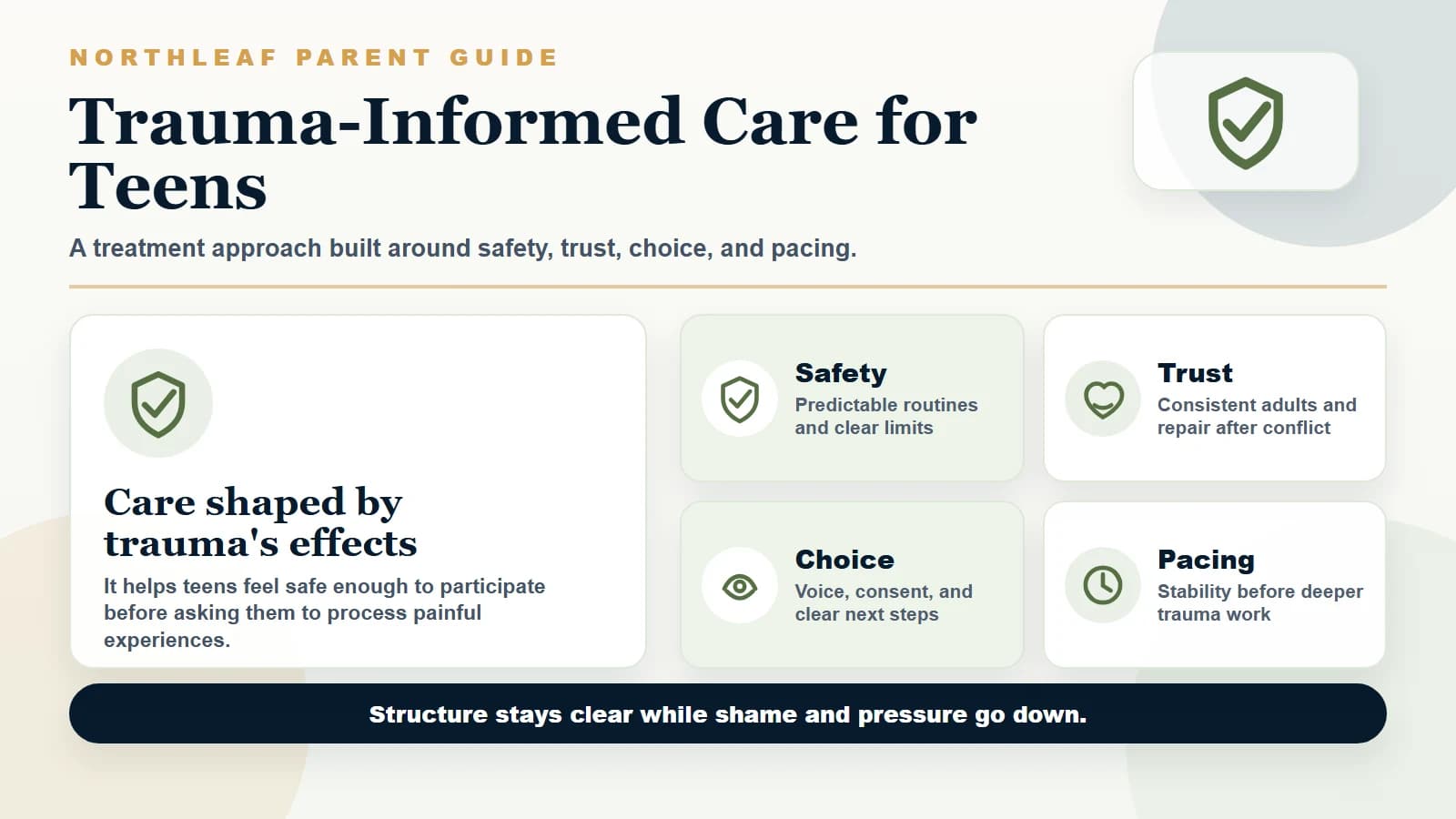
What trauma-informed care means for teens and why safety, trust, pacing, routines, and family involvement matter in treatment.
By NorthLeaf Editorial Team
Read Guide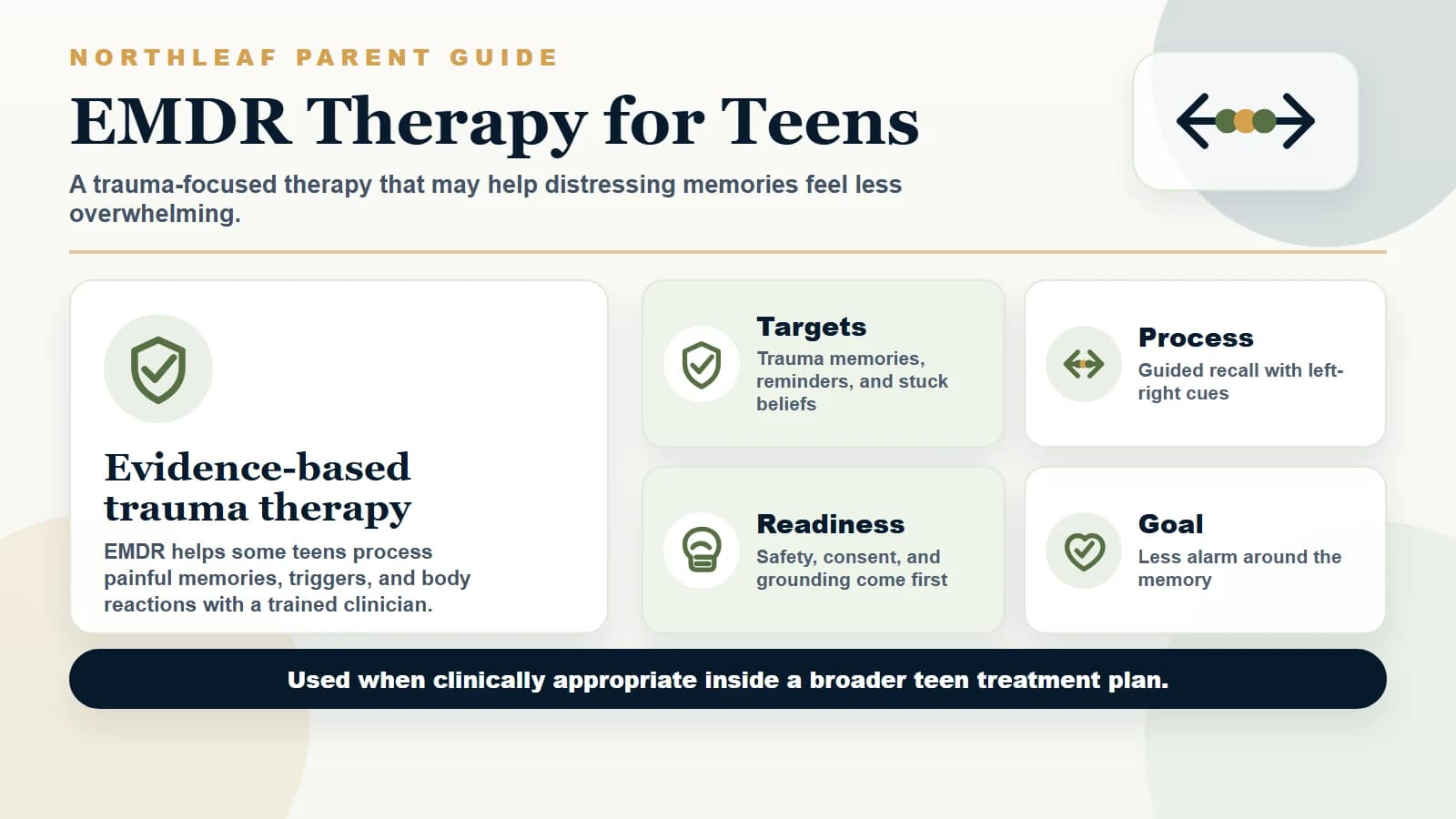
A parent guide to EMDR therapy for teens, including how it works, bilateral stimulation, readiness, safety, and residential treatment fit.
By NorthLeaf Editorial Team
Read Guide
A parent-friendly explanation of co-occurring disorders in teen mental health and why overlapping symptoms require careful treatment planning.
By NorthLeaf Editorial Team
Read GuideRelated services
Common questions
Speak with admissions about what your teen is experiencing, whether residential support may be appropriate to explore, and how to begin insurance verification.