
What Is Cognitive Behavioral Therapy (CBT)?
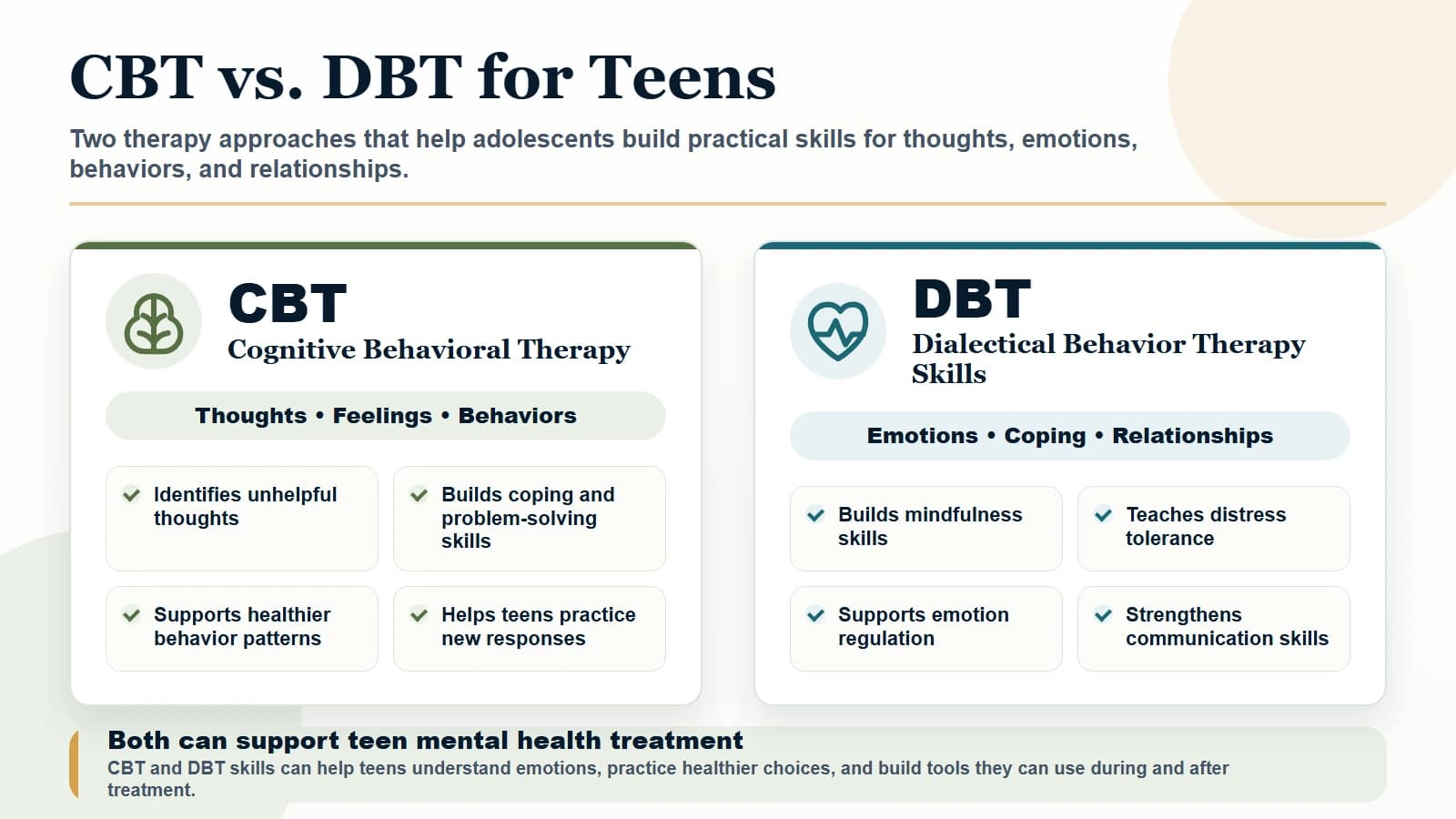
Cognitive behavioral therapy is a structured form of psychotherapy that helps people notice patterns between thoughts, emotions, body sensations, choices, and situations. For adolescents, CBT is often most helpful when it becomes practical: naming the anxious thought, testing whether it is fully accurate, practicing a different response, and noticing what happens next.
- Identifying automatic thoughts that may be inaccurate, rigid, or self-defeating.
- Connecting emotions with behavior patterns such as avoidance, withdrawal, reassurance seeking, or conflict.
- Practicing coping steps in real situations rather than only talking about them after the fact.
How CBT Is Used in Adolescent Residential Treatment
In a residential setting, CBT-informed work can be reinforced across the day. A teen can learn a skill in therapy, practice it during schoolwork or peer interaction, and then process what worked with staff or clinicians. That repetition matters because many families are not just looking for insight; they are looking for day-to-day change that can survive stress.
What parents can look for
Parents do not need to become therapists, but they can ask whether a program helps teens translate insight into behavior. Strong CBT-informed care should be concrete enough for a teen to name the pattern they are working on and the skill they are practicing.
- Does treatment include measurable goals tied to school, sleep, family communication, safety, or routines?
- How are coping skills practiced outside individual therapy sessions?
- How will parents learn the language their teen is using in treatment?
CBT should not sound like arguing with feelings
CBT is sometimes misunderstood as telling a teen their thoughts are wrong or trying to talk them out of pain. Good adolescent CBT is more respectful than that. It helps the teen notice when anxiety, depression, shame, or avoidance is making one interpretation feel like the only truth. The work is not to invalidate emotion; it is to create enough space for another response.
- A depressed teen may practice separating a feeling of failure from the conclusion that nothing can change.
- An anxious teen may practice tolerating uncertainty instead of waiting for perfect reassurance.
- A teen avoiding school may practice smaller return-to-functioning steps instead of being pushed from zero to full participation.
How CBT connects to family and school
For teens, CBT usually becomes more useful when the surrounding adults understand the pattern. Parents may need help responding to reassurance seeking, avoidance, shutdown, or negative self-talk. Schools may need a plan that supports gradual participation without making avoidance permanent. The skills are stronger when the environment reinforces them consistently.