
EMDR Therapy for Teens: What Parents Should Know
Parents researching trauma treatment for children and teens often come across EMDR, which stands for Eye Movement Desensitization and Reprocessing. The name sounds technical, and some online explanations make it seem either mysterious or almost magical. The reality is more grounded: EMDR is a structured trauma-focused therapy used by trained clinicians to help people process distressing memories and the beliefs, body reactions, and triggers connected to them.
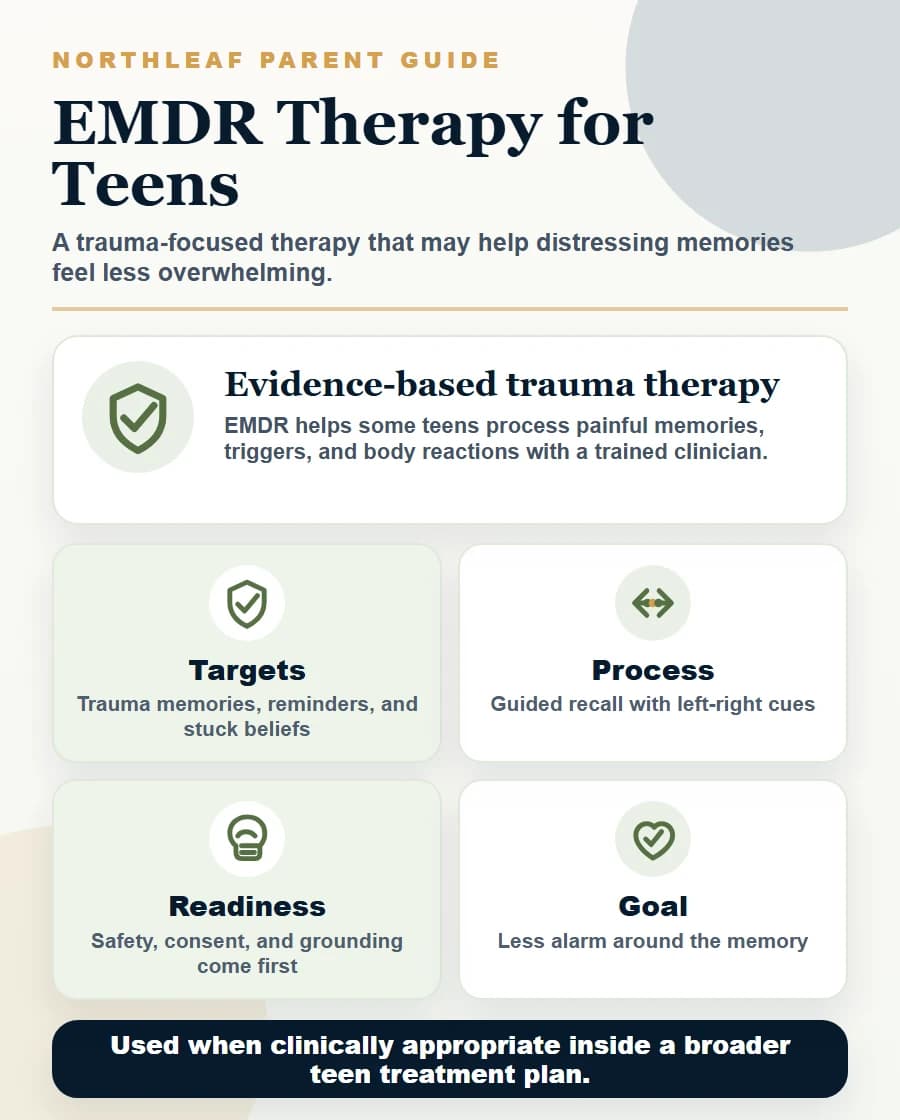
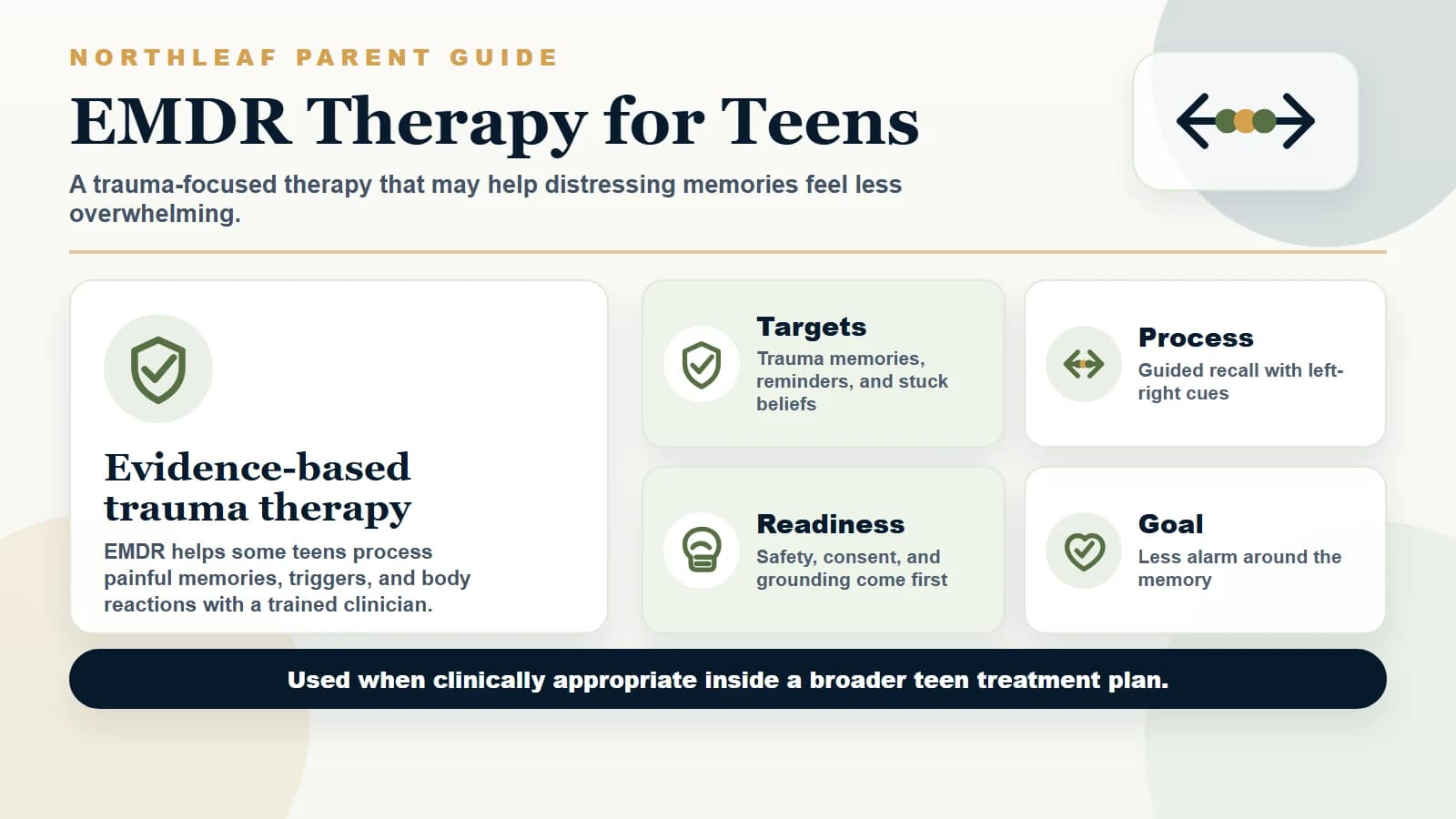
NorthLeaf offers EMDR when it is clinically appropriate for a teen's symptoms, readiness, safety needs, consent, and broader residential treatment plan. That careful wording matters. EMDR can be helpful for some adolescents, especially when trauma reminders are keeping the nervous system on alert, but it is not a universal fit for every teen, every trauma history, or every stage of treatment.
What is EMDR therapy?
EMDR is not simply talking about trauma while moving the eyes. It is a phased therapy that includes history taking, preparation, assessment of the target memory or belief, bilateral stimulation, reprocessing, closure, and reevaluation. Bilateral stimulation means the teen pays attention to alternating left-right cues. Those cues may involve eye movements, tapping, tones, or another clinician-directed method.
The goal is not to erase memories or convince a teen that painful experiences did not matter. A better way to explain it is that EMDR may help a memory feel less stuck in the present. The teen may still remember what happened, but the memory can become less emotionally overwhelming, less physically activating, and less tied to beliefs such as "I am not safe," "It was my fault," or "I cannot handle this."
NorthLeaf Parent Guide
EMDR therapy for teens
A practical view of when EMDR may help, what the process usually includes, and why readiness matters before trauma processing begins.
Where EMDR may fit
Trauma reminders and stuck reactions
EMDR may be considered when painful memories, body reactions, avoidance, or beliefs such as "I am not safe" keep showing up in the present.
How it usually works
- 1Safety and historyThe clinician reviews symptoms, risks, supports, goals, and whether trauma processing is appropriate now.
- 2Preparation and groundingThe teen practices ways to calm the body and stay oriented before any memory processing begins.
- 3Bilateral cuesThe clinician may use eye movements, tapping, tones, or another left-right cue while checking tolerance.
- 4ReprocessingThe teen notices what comes up in short sets. The goal is not to erase the memory, but to reduce how overwhelming it feels.
- 5Closure and check-inEach session ends with stabilization, next steps, and a plan for support if feelings come up later.
Readiness First
EMDR may need to wait if a teen is unsafe, medically unstable, highly dissociative, actively using substances, or not ready to consent.
At NorthLeaf
EMDR is one available tool inside a broader plan that may also include skills practice, family therapy, psychiatric care, academic support, and aftercare planning.
How EMDR is adapted for teens
Teen trauma treatment has to be developmentally appropriate. Some adolescents can talk directly about trauma. Others shut down, minimize, get angry, intellectualize, dissociate, or say they do not remember enough to explain it. A trained clinician should adapt the pace, language, and amount of detail to the teen's age, symptoms, safety, and trust.
For younger teens or teens who struggle to verbalize emotions, EMDR may include simpler explanations, more preparation, shorter processing sets, drawing, body-based check-ins, or concrete grounding skills. Parents should not expect a teen to give a dramatic retelling of everything that happened. Responsible trauma work protects the teen's privacy and emotional safety while still keeping caregivers informed about treatment goals, safety planning, and general progress.
Who may benefit from EMDR?
EMDR is most often discussed in connection with trauma and PTSD, but parents may hear about it when a teen is struggling after accidents, assaults, bullying, grief, medical trauma, painful family experiences, frightening events, or repeated exposure to situations that made the teen feel unsafe. Some teens experience trauma through nightmares, avoidance, panic, anger, numbness, emotional reactivity, shame, sleep disruption, body tension, school refusal, or sudden shifts in mood.
That does not mean every anxious or depressed teen needs EMDR. Anxiety, depression, substance use, eating concerns, family conflict, ADHD, social stress, and school avoidance can have many causes. EMDR is most relevant when distress is connected to painful memories, trauma reminders, intrusive images, body reactions, or beliefs that seem locked in place even when the teen understands they are no longer in immediate danger.
How EMDR usually works
EMDR is usually described as an eight-phase therapy, but parents do not need to memorize the phases to ask good questions. In plain language, responsible EMDR starts with understanding the teen's history, symptoms, safety, strengths, and current supports. The clinician then prepares the teen with grounding skills, explains what will happen, gets consent, and helps identify a target memory, image, body sensation, or negative belief.
During processing, the teen pays attention to bilateral stimulation while noticing what comes up. The clinician checks in between sets and helps the teen stay within a tolerable range of distress. Over time, the memory may become less activating, the body may calm more quickly, and healthier beliefs may become easier to access. Each session should end with closure and a plan for what to do if feelings come up later.
Readiness matters more than enthusiasm
Parents may feel hopeful when they hear that a therapy could help trauma symptoms, especially if their teen has been stuck for a long time. Hope is important, but readiness is more important. A clinician should assess safety, dissociation, emotional regulation, current stressors, substance use, medical stability, sleep, family context, and the teen's ability to use grounding skills before beginning trauma processing.
For some teens, the most therapeutic first step is not trauma processing. It may be sleep stabilization, distress tolerance, medication evaluation, family safety planning, substance-use stabilization, school stabilization, or building enough trust to stay engaged in treatment. Delaying EMDR does not mean trauma is being ignored. It may mean the team is protecting the teen from moving too fast.
When EMDR may not be the first step
EMDR may need to wait if a teen is actively suicidal, repeatedly self-harming, intoxicated, in withdrawal, medically unstable, severely dissociative, unable to tolerate basic distress, or unwilling to participate. It may also need careful sequencing when there is ongoing danger, intense family conflict, eating disorder medical risk, psychosis, mania, or a level of crisis that requires immediate stabilization first.
This is one reason a residential setting can be useful for some teens. When trauma work is clinically appropriate, the teen is not expected to handle the emotional aftermath alone between weekly outpatient appointments. Skills practice, staff support, family work, psychiatric oversight when needed, school planning, and aftercare preparation can all support the larger treatment plan.
What parents may notice around EMDR sessions
Some teens feel tired after trauma work. Some have dreams, emotional sensitivity, temporary increases in memories, or new connections between feelings and past experiences. Others feel relieved, calmer, or simply unsure what changed. Parents should ask the treatment team what is normal, what would be concerning, and how caregivers should respond if their teen is more quiet, irritable, or emotionally open after a session.
The parent role is not to interrogate the teen about what happened in therapy. A better role is to support sleep, meals, routines, safety, and steady connection. If a teen wants to talk, parents can listen without forcing details. If the teen does not want to talk, parents can still communicate calm availability: "You do not have to explain everything to me right now. I am here, and I am glad you are getting support."
How EMDR fits inside NorthLeaf's residential care
At NorthLeaf, EMDR is one available clinical tool, not the whole treatment plan. A teen may also need CBT-informed coping skills, DBT-informed emotion regulation, family therapy, psychiatric assessment, medication management, academic support, substance-use support, eating-disorder-informed care, and discharge planning. EMDR should connect to those supports rather than sit off to the side as a separate technique.
Parents can ask how the team decides whether EMDR is appropriate, who provides it, how the teen's consent is handled, what stabilization skills are taught first, and what happens if EMDR increases distress. Those questions are not obstacles to care. They are signs that parents are thinking about trauma treatment responsibly.
Questions parents can ask about EMDR
- Are EMDR-trained clinicians available for adolescents, and what training have they completed?
- How do you decide whether my teen is ready for trauma processing?
- What stabilization and grounding skills are taught before EMDR begins?
- How do you handle consent if my teen does not want to participate?
- How are parents involved while still protecting my teen's privacy?
- What signs would tell you to pause EMDR or use another intervention first?
- How does EMDR connect with family therapy, safety planning, psychiatric care, school planning, and aftercare?
What if EMDR is not recommended right now?
A no to EMDR right now should not mean a no to trauma-informed support. Teens can still work on grounding, sleep, coping skills, emotional regulation, family communication, routines, safety, and trust. Trauma-informed care can shape every part of treatment, even when formal trauma processing is paused or not appropriate yet.
The best treatment plan is not the one with the most impressive therapy names. It is the one that fits the teen's current clinical reality, protects safety, builds readiness, involves family in a useful way, and keeps the teen moving toward a life that feels less ruled by fear, shame, avoidance, or old pain.