
Ages 12-17 with a major depressive episode
20.1%
NIMH reports that about one in five U.S. adolescents ages 12-17 had a past-year major depressive episode in 2021.
Mood and emotional stability
Parent guidance on intense emotions, mood instability, depression, possible bipolar-spectrum concerns, safety, school, and family impact.

Mood and safety context
A webpage cannot diagnose depression, bipolar disorder, or another mood disorder. National data can help families understand why mood, sleep, energy, risk-taking, school impact, and safety statements deserve careful assessment by qualified professionals.
20.1%
NIMH reports that about one in five U.S. adolescents ages 12-17 had a past-year major depressive episode in 2021.
2.9%
NIMH reports estimated lifetime prevalence of bipolar disorder among adolescents ages 13-18.
82.9%
NIMH reports severe impairment among most adolescents with bipolar disorder in national survey data.
40%
CDC 2023 YRBS data show persistent sadness or hopelessness remains widespread among high school students.
Understanding the concern
A diagnosis or symptom pattern is only one part of the picture. Families also need to consider safety, functioning, school, relationships, routines, and what level of support is realistic at home.
Mood disorders in teens require careful assessment because mood symptoms can overlap with depression, anxiety, trauma, ADHD, substance use, sleep problems, family stress, and developmental changes. Parents may notice intense emotions, withdrawal, irritability, low motivation, or periods when a teen seems unusually energized, impulsive, or unable to settle.
A webpage cannot diagnose a mood disorder. What families can do is track patterns: sleep, energy, school functioning, risk-taking, safety statements, irritability, medication changes, substance use, and how long mood shifts last. That information helps clinicians understand what needs assessment.
Teens can be intense, reactive, private, dramatic, funny, irritable, and exhausted without having a mood disorder. The concern grows when mood changes are persistent, impairing, unsafe, unusual for the teen, tied to major sleep or energy changes, or strong enough to disrupt school, relationships, judgment, or family functioning.
Parents may notice a teen who disappears into depression for days, erupts over small limits, cycles between apology and explosion, sleeps almost all day, stops sleeping, becomes unusually energized or impulsive, or makes risky choices that do not fit their baseline. The pattern matters more than any single hard day.
Many families expect depression to look sad and bipolar-spectrum concerns to look obviously euphoric. In adolescents, mood symptoms may show up as irritability, rage, agitation, impulsivity, reckless behavior, shutdown, numbness, or conflict that feels much bigger than the trigger. A teen may not have language for mood changes and may only show the family the anger on top.
That does not mean every angry teen has a mood disorder. It means treatment planning should look at sleep, energy, duration, impairment, risk-taking, family history, medication changes, substance use, and whether the teen can recover and repair after intense episodes.
Sleep is one of the most useful patterns for parents to track. Depression may involve sleeping much more, sleeping poorly, or staying up all night and then collapsing. Possible manic or hypomanic symptoms may involve decreased need for sleep with increased energy, pressured activity, impulsivity, racing thoughts, or risk-taking. These patterns require professional assessment.
A teen who is simply overtired may also be emotional and reactive. That is why families should track what actually happens over time: bedtime, wake time, energy, activity level, speech, appetite, school attendance, conflicts, substance use, safety statements, and medication changes.
Mood symptoms become urgent when they involve suicidal thoughts, self-harm, psychosis, severe agitation, dangerous impulsivity, aggression, intoxication, inability to sleep for extended periods with escalating behavior, or inability to stay safe. In those situations, emergency evaluation may be needed before any residential admissions discussion.
Residential treatment may be appropriate after immediate safety is addressed when a teen needs more structure than outpatient care can provide. The plan should include psychiatric assessment when indicated, sleep stabilization, safety planning, emotion-regulation skills, family work, school support, and aftercare.
Signs and symptoms
The signs below should not be used for diagnosis. They are starting points for a conversation with a qualified professional or admissions specialist.
Parent planning
A clear pattern is more useful than a perfect label. Before an admissions or clinical conversation, parents can write down what they are seeing, how often it happens, and how it affects daily life.
Daily life impact
Mood instability can affect family trust, peer relationships, school attendance, sleep, safety, and the teen's ability to repair after conflict. Parents may feel unsure whether to set limits, comfort the teen, seek emergency help, or wait for the mood to pass.
Daily life may become hard to predict. A calm morning can turn into a shutdown by lunch. A small correction can become hours of conflict. A teen may apologize and mean it, then repeat the same pattern the next day. Parents may start managing the entire household around the teen's mood.
A useful plan helps the family separate pattern from personality. What is the mood doing to sleep, school, energy, choices, safety, and relationships? What helps the teen return to baseline? What makes escalation worse? Those answers matter more than arguing about whether the teen is being dramatic.
Residential treatment fit
Residential treatment may be worth discussing when mood symptoms are affecting safety, school, family stability, sleep, or daily functioning and outpatient support is not enough. Immediate suicidal risk, psychosis, severe agitation, or medical instability may require emergency or inpatient care first.
It may also be worth discussing when mood symptoms overlap with self-harm, suicidal thoughts, substance use, trauma, school refusal, aggression, or severe family conflict, and when the teen needs more observation and structure than weekly outpatient treatment can provide.
Mood concerns with possible bipolar-spectrum symptoms should be assessed carefully by qualified professionals. Families should ask how psychiatric evaluation, medication questions, sleep stabilization, safety planning, and emergency escalation are handled.
Treatment approach
Treatment planning may include psychiatric evaluation, therapy, sleep stabilization, emotion regulation skills, family work, safety planning, school support, and careful aftercare. Medication questions should be addressed by qualified prescribers.
Treatment should help the teen and family identify early warning signs. For one teen, the warning sign may be sleeping all day. For another, it may be not sleeping, talking faster, becoming unusually driven, taking risks, or feeling invincible. For another, it may be irritability, isolation, or sudden hopelessness.
A residential setting can sometimes help by observing patterns across the day rather than relying only on one therapy hour. Sleep, peer interaction, academic work, family contact, emotional recovery, and safety statements all provide information for a better plan.
NorthLeaf support
Treatment planning should connect symptoms with daily functioning, safety, family needs, school needs, and the next level of support after residential care.
Deeper parent guide
These sections are written for parents who need more than a symptom checklist. They focus on the patterns that can keep a teen stuck, what families often miss, and what good treatment planning should clarify before any level-of-care decision.
Mood disorder language can become confusing for families because teens may show depression, irritability, impulsivity, sleep disruption, energy changes, agitation, shutdown, or dramatic shifts over time. The pattern matters more than a quick label.
A best-in-class page should be careful: not every mood swing is bipolar disorder, and not every angry teen has a mood disorder. At the same time, severe or persistent mood instability deserves serious assessment because it can affect safety, school, relationships, and treatment planning.
Parents need language for tracking sleep, energy, risk-taking, irritability, low mood, suicidal thoughts, self-harm, substance use, medication changes, and family history without trying to diagnose at home.
Parents can say: 'We are going to track the pattern, not argue about whether this is your fault. Sleep, safety, energy, and choices all matter, and we need help understanding the whole picture.'
NorthLeaf treats adolescents whose mood instability is disrupting safety, daily functioning, school, relationships, or outpatient progress and who need more structure than outpatient care can provide. Emergency evaluation may be needed first if there is imminent risk, psychosis, mania-like severe impairment, or inability to maintain safety.
Family involvement can help parents distinguish patterns from one-time conflicts, respond to escalation, support sleep and routines, and prepare for safety planning if mood symptoms worsen.
Parents may need coaching on when to validate, when to set limits, how to avoid escalating a mood episode, how to talk about safety, and how to repair after conflict. Family work should reduce shame while still taking risk and functioning seriously.
Mood symptoms can interfere with attendance, motivation, concentration, behavior, and peer interactions. Academic planning should be realistic and coordinated with the clinical picture.
When mood symptoms are active, school recovery may need to happen in stages. Attendance, sleep, workload triage, teacher communication, and counselor support may matter more at first than trying to recover every missing assignment at once.
Related conditions
Support for teens whose anxiety is making life smaller at school, at home, with friends, or in daily routines.
Support for adolescents experiencing persistent sadness, withdrawal, low motivation, or emotional heaviness.
Support for teens navigating painful experiences, emotional reactivity, avoidance, or distress.
Related resources

A parent-friendly explanation of co-occurring disorders in teen mental health and why overlapping symptoms require careful treatment planning.
By NorthLeaf Editorial Team
Read Guide
How teen depression can affect school, motivation, family communication, sleep, safety, and when parents should ask for more support.
By NorthLeaf Editorial Team
Read Guide
Practical ways parents can talk with a teen who shuts down, avoids questions, or responds with silence, anger, or one-word answers.
By NorthLeaf Editorial Team
Read Guide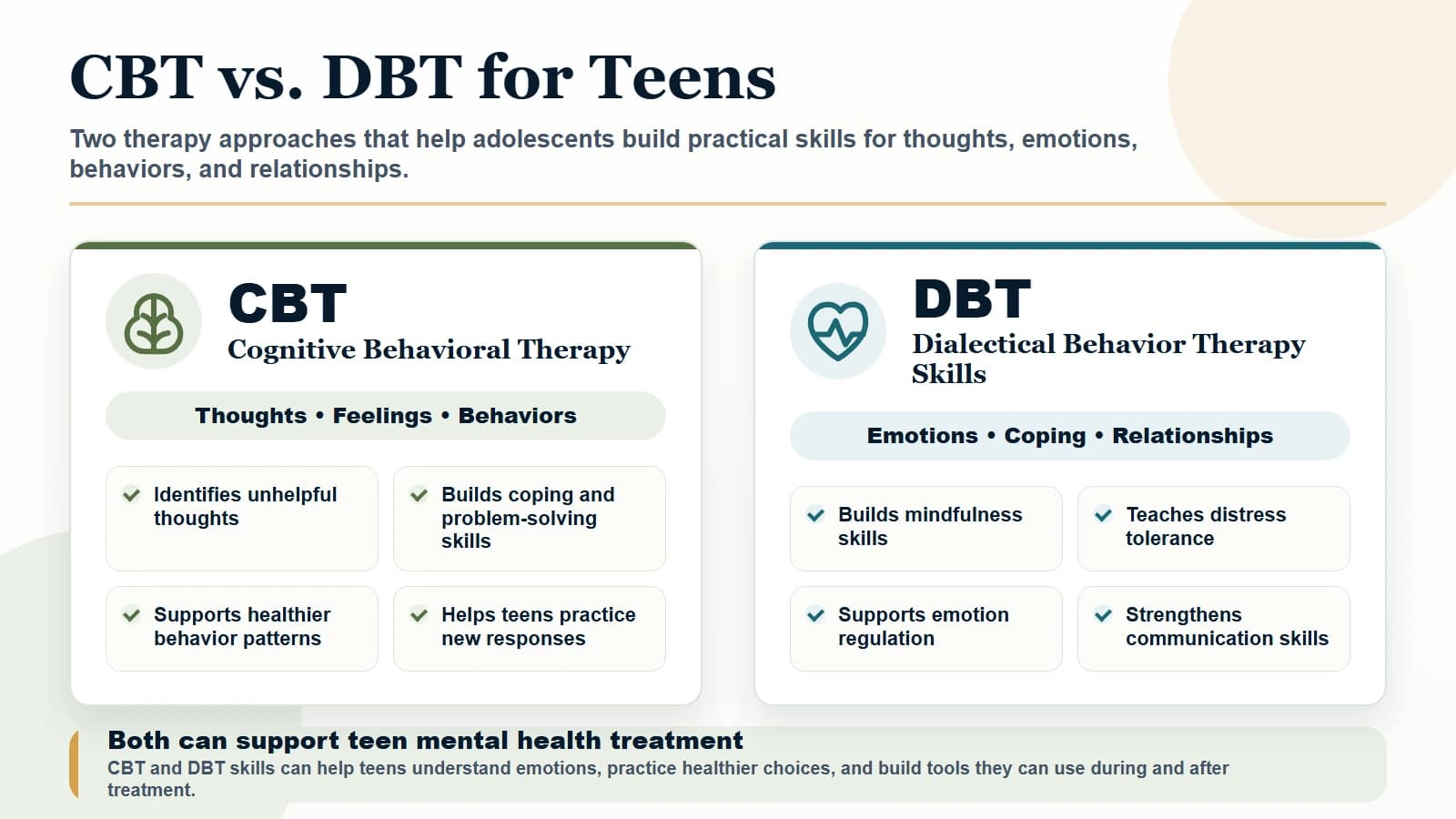
A parent-friendly comparison of CBT and DBT skills for teens, including anxiety, depression, self-harm, emotional regulation, and family support.
By NorthLeaf Editorial Team
Read GuideRelated services
Common questions
Speak with admissions about what your teen is experiencing, whether residential support may be appropriate to explore, and how to begin insurance verification.