
Ages 13-18 with any anxiety disorder
31.9%
NIMH reports lifetime prevalence of any anxiety disorder among adolescents ages 13-18.
Teen anxiety support
Guidance for families when anxiety starts shrinking a teen's life, disrupting school, changing routines, and pulling everyone into reassurance, rescue, conflict, or avoidance.

Anxiety by the numbers
The numbers below use national adolescent mental health sources. They are not a diagnosis for any one teen, but they help show why anxiety should be taken seriously when it starts affecting school, sleep, family life, or safety.
31.9%
NIMH reports lifetime prevalence of any anxiety disorder among adolescents ages 13-18.
8.3%
NIMH reports severe impairment for a meaningful subset of adolescents with anxiety disorders.
18.8%
CDC 2021-2023 data show fewer than one in five adolescents received mental health therapy in the past year.
40%
CDC 2023 YRBS data show broad distress among high school students, often overlapping with anxiety, depression, avoidance, and safety concerns.
Understanding the concern
A diagnosis or symptom pattern is only one part of the picture. Families also need to consider safety, functioning, school, relationships, routines, and what level of support is realistic at home.
Teen anxiety is not just fear. It is a life getting smaller. A teen may understand that a fear is exaggerated and still feel unable to enter school, join a group, sleep alone, complete an assignment, eat in front of others, answer a text, or stop asking for reassurance. Families often notice the pattern before they know what to call it: mornings become battles, routines become fragile, and parents begin planning the household around anxiety.
Anxiety often begins quietly. A missed assignment. A skipped practice. A stomachache before school. A parent giving reassurance one more time because everyone is exhausted. Over time, the teen's world can get smaller, and the family's life can start orbiting around what anxiety will allow.
Anxiety can show up as panic, avoidance, irritability, perfectionism, physical complaints, school refusal, shutdown, anger, clinginess, reassurance seeking, or constant checking. The goal is not to shame a teen out of fear. The goal is to understand what anxiety is protecting them from, how avoidance is reinforcing the cycle, and what level of support can help the teen take safer, manageable steps forward.
Anxiety rarely stays contained inside the teen. It pulls the family system into the pattern. Parents may begin waking earlier to negotiate school, answering the same question many times, sending long reassurance texts, canceling plans, sleeping near the teen, changing meals, avoiding certain roads, emailing teachers, or reducing expectations to prevent escalation. Those responses often come from love and exhaustion. They may also teach anxiety that avoidance is the fastest way to feel safe.
This does not mean parents caused the anxiety. Family stress can be part of the story for some teens, but even when it is not, anxiety often becomes a family-level problem because everyone adapts around it. A helpful treatment plan does not blame parents for accommodating anxiety. It helps the family see the cycle clearly. The teen learns how fear, body sensations, thoughts, and avoidance interact. Parents learn how to validate distress without letting anxiety make every decision.
The difference is subtle but important. The goal is not to force a teen through fear or tell parents to stop helping. The goal is to help the teen build tolerance with enough structure and support while parents practice responses that reduce long-term avoidance rather than only quieting anxiety for the next hour.
For many families, anxiety becomes impossible to ignore when school starts to fall apart. The teen may miss first period, ask to come home early, spend hours on assignments, avoid presentations, stop attending activities, or refuse school entirely. The problem may look like defiance from the outside, but underneath it may involve panic, fear of judgment, perfectionism, sensory overload, bullying, academic shame, trauma reminders, depression, sleep disruption, or a combination of concerns.
School planning should be practical. A teen may need coordinated expectations, attendance goals, communication with school staff, accommodations when appropriate, and a gradual plan for re-engagement. At the same time, adults should avoid making school the only measure of progress. Stabilization, safety, sleep, eating, coping skills, and family communication may need attention before academic pressure can become productive again.
Evidence-based anxiety treatment often includes cognitive behavioral therapy, education about the anxiety cycle, skills for tolerating body sensations, gradual practice with avoided situations, family coaching, and relapse-prevention planning. The American Academy of Child and Adolescent Psychiatry guideline supports cognitive behavioral therapy and selective serotonin reuptake inhibitors for many children and adolescents with anxiety disorders, depending on diagnosis, severity, family preference, and clinical fit.
The most important question is not whether a website can name a therapy. It is whether the plan helps the teen practice skills beyond the therapy room. If a teen can talk about anxiety for 50 minutes but still freezes in the car before school, needs the same reassurance 11 times, or cannot reduce avoidance at home, the family may need more structured practice, more coaching, or a different level of care.
Outpatient therapy is often the right starting point for teen anxiety. A higher level of care may be worth discussing when anxiety is paired with major school refusal, escalating family conflict, panic that disrupts daily life, depression, self-harm, suicidal thoughts, substance use, trauma symptoms, eating concerns, or a home environment that can no longer provide enough structure. Residential treatment is not for ordinary worry. It is considered when the teen's functioning, safety, or stability needs more support across the day.
If a teen is in immediate danger, may harm themselves, has a suicide plan, has access to lethal means, or cannot stay safe, emergency support comes first. Call 911, go to the nearest emergency room, or call or text 988 in the United States. A scheduled admissions conversation or website article is not a substitute for emergency care.
Signs and symptoms
The signs below should not be used for diagnosis. They are starting points for a conversation with a qualified professional or admissions specialist.
Parent planning
A clear pattern is more useful than a perfect label. Before an admissions or clinical conversation, parents can write down what they are seeing, how often it happens, and how it affects daily life.
Daily life impact
Anxiety can affect school attendance, sleep, eating, family plans, friendships, sports, medical appointments, hygiene, independence, and the teen's willingness to try ordinary age-appropriate responsibilities. Parents may find themselves giving more reassurance, changing plans, emailing teachers, lowering expectations, or avoiding anything that might trigger a panic response.
Those accommodations can be compassionate in the short term, especially when a teen is overwhelmed. Over time, however, anxiety may become the decision-maker for the family. Parents can feel trapped between two bad options: push and risk a meltdown, or accommodate and watch their teen's world shrink. A treatment plan should help parents support brave steps without pushing so hard that the teen feels abandoned or unsafe.
Families may also see anxiety affect siblings and caregivers. Siblings may resent canceled plans or special rules. Parents may disagree about how firm to be. Caregivers may lose sleep monitoring panic, school refusal, or reassurance loops. Naming the family-wide impact matters because anxiety treatment usually works best when home responses change alongside the teen's own skills.
Residential treatment fit
Residential treatment may be appropriate to discuss when anxiety is severely affecting school, sleep, family stability, safety, or daily functioning and outpatient support is not enough. It may also be considered when anxiety overlaps with depression, self-harm, trauma, substance use, eating concerns, or other issues that require more structure throughout the day.
The question is not whether a teen feels anxious. Many teens do. The question is whether anxiety is now controlling the teen's routine, preventing progress in outpatient care, creating safety concerns, or overwhelming the family's ability to provide consistent support. A residential setting can sometimes help by creating a predictable therapeutic day, more frequent skills practice, family coaching, academic support, and clinical observation across transitions rather than only during a weekly appointment.
Residential care is not the same as emergency psychiatric hospitalization. If risk is active or immediate, emergency evaluation comes first. If the teen is medically or psychiatrically unstable, another level of care may be required before residential treatment is appropriate.
Treatment approach
Anxiety treatment often includes education about the anxiety cycle, CBT-informed work with thoughts and avoidance, gradual skill practice, emotion regulation, family support, and school planning. The teen may need help tolerating discomfort in small steps while parents learn how to validate fear without letting fear run the household.
A strong plan should be concrete enough for daily life. Instead of only saying, "use coping skills," the team should help the teen know which skill to use before school, during panic symptoms, after conflict, at bedtime, or when reassurance urges appear. Parents should understand which responses are supportive, which responses accidentally feed the anxiety cycle, and how to repair after a difficult moment.
Care planning should also look for overlapping concerns. Anxiety can hide depression, trauma symptoms, ADHD, substance use, eating concerns, obsessive patterns, bullying, family stress, or sleep problems. Treating only the visible anxiety may not be enough if another concern is maintaining the pattern.
NorthLeaf support
Treatment planning should connect symptoms with daily functioning, safety, family needs, school needs, and the next level of support after residential care.
Deeper parent guide
These sections are written for parents who need more than a symptom checklist. They focus on the patterns that can keep a teen stuck, what families often miss, and what good treatment planning should clarify before any level-of-care decision.
Anxiety in adolescents is often less about one feared object and more about a loop: body alarm, catastrophic prediction, avoidance, short-term relief, and then a smaller life. The teen may know the fear is bigger than the situation and still feel trapped by the physical urgency of it.
Families can become part of the loop without doing anything wrong. Reassurance, rescue, schedule changes, repeated checking, and avoiding conflict can all lower distress in the moment while accidentally teaching the nervous system that the feared situation could not be survived.
A strong anxiety page should not only list symptoms. It should help parents recognize how anxiety changes school attendance, sleep, family flexibility, friendships, technology use, meals, perfectionism, and the teen's willingness to tolerate normal uncertainty.
A steadier parent sentence is often: 'I believe this feels real in your body, and I am not going to argue with the fear. I am going to help you take the next safe step instead of letting anxiety decide the whole day.'
NorthLeaf's PRTF/residential level of care is designed for adolescents whose anxiety has narrowed life so much that outpatient appointments are not enough to restore school attendance, sleep, meals, hygiene, safety, family functioning, or skill practice. The clinical question is whether the teen needs structured support across the day rather than only weekly outpatient touchpoints.
Family involvement can help parents reduce reassurance loops, respond to panic more consistently, support gradual practice with avoided situations, and create routines that do not revolve entirely around anxiety.
Parents often need language that is both warm and firm. A helpful response might validate the fear, name the next small step, and avoid a long debate with anxiety. Family work can also help parents coordinate expectations so one caregiver is not rescuing while another is escalating conflict.
Anxiety often becomes visible at school. Support may involve attendance planning, realistic academic expectations, coordination with school staff, and strategies for returning to class without turning every assignment into a crisis.
Some teens need help separating academic recovery from emotional stabilization. A school plan can protect progress by clarifying what work matters most, how communication will happen, when accommodations may help, and how the teen will return to more independence without being flooded by shame.
Related conditions
Support for adolescents experiencing persistent sadness, withdrawal, low motivation, or emotional heaviness.
Support for teens navigating painful experiences, emotional reactivity, avoidance, or distress.
Clinically responsible guidance when self-harm behaviors or urges require careful safety planning and support.
Related resources

Practical guidance for parents supporting a teen with anxiety while watching for safety, school, avoidance, and functioning concerns.
By NorthLeaf Editorial Team
Read Guide
A parent guide to teen social anxiety, school avoidance, friendships, performance fear, reassurance cycles, gradual exposure, and treatment planning.
By NorthLeaf Editorial Team
Read Guide
How parents can tell the difference between normal teen stress and anxiety that is interfering with school, sleep, routines, and daily life.
By NorthLeaf Editorial Team
Read Guide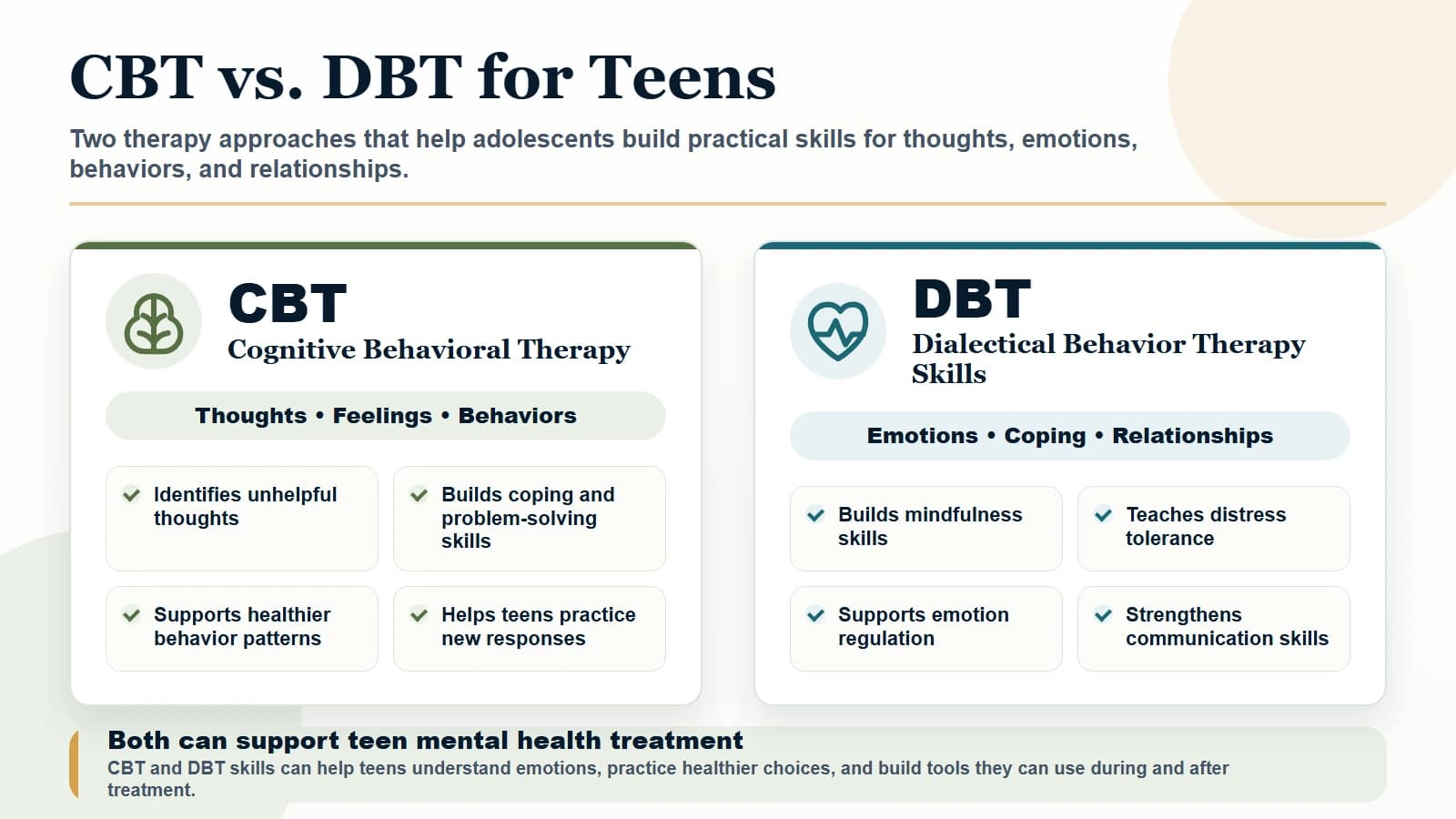
A parent-friendly comparison of CBT and DBT skills for teens, including anxiety, depression, self-harm, emotional regulation, and family support.
By NorthLeaf Editorial Team
Read GuideRelated services
Common questions
Speak with admissions about what your teen is experiencing, whether residential support may be appropriate to explore, and how to begin insurance verification.